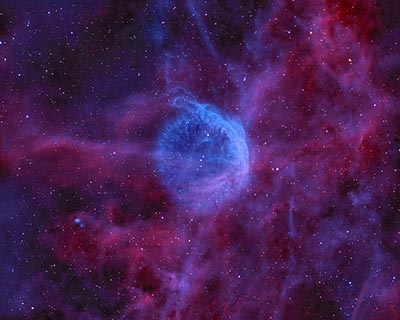
WR134 in Cygnus - The Cygnus Blue Eye Nebula
with 10" f/3.9 Astrograph
Uploaded 9/28/25

|
If you think the Squid
nebula in Cepheus or the Rice Hat nebula in Auriga is really
faint - think again. Getting a clear capture of the WR134 bubble
which is 10x fainter, is an incredible processing challenge for
all imagers. Known as the "Cygnus Blue Eye" nebula,
it is located in central Cygnus near the Crescent nebula. This
32 hour exposure set took many nights and several months over
the summer and reveals that the Wolf-Rayet bubble is perched
in an ocean of red and pink hydrogen nebulosity amongst countless
stars. Notice that the OIII nebular wisps do not always correspond
to the Halpha tendrills. Perhaps these are remnants of an earlier
ejection episode. A nice little blue reflection nebula sits to
its left and is seldom recorded.
Technical Data: 10"
f/3.9 Newtonian astrograph, Atik 16200 CCD, Ha_OIII_RGB = 32
hours total, Payson, Az.
|
|
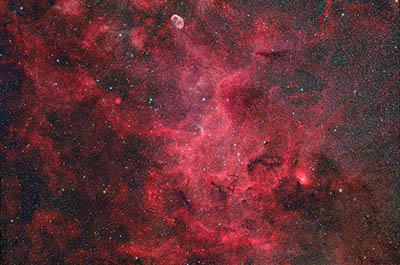
Here are two images
which were taken at the same time as the WR134 image I posted
earlier this week. These are "Context" images, and
show a field centered on the primary target but with a 5x larger
field as to put the target seen in the 10 inch into context.
This type of imaging in pairs is incredibly useful, not only
does it give you the over all field surrounding your primary
target, it reveals targets for future imaging with your longer
focal length setup. The first unlabeled image shows the blue/green
arc of WR134 right in the center swimming in a sea of pink hydrogen.
At the top is the Crescent nebula, and lower right the Tulip
nebula. I really had no idea there was so much to see here. The
second image Ive marked the field size of the 10 inch around
several interesting targets with WR134 at center. I really love
the sharp field of view and crisp nebula details Im getting with
the MiniCat 51. The secret to images like this are first getting
a good tilt alignment on the lenses camera mount using ASTAP
freeware, and then the inclusion of a UV/IR Blocker filter (Luminance)
in the optical path. Ill be posting many more images in the future
with this dual setup, so keep and eye out for them.
Technical Data: MiniCat
51mm f/3.5 astrograph, ASI2600 MC + Baader UV/IR Blocker, IDAS
NBZ2, 6 hours total, Payson, Az.
|
 |
Unlabeled full field
Select an image size for a larger view:

1600 x 1290
|
 |
Labeled field

Select an image size for a larger view:

1600 x 1290
|
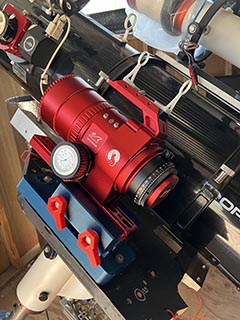 |
Williams Optics MiniCat 51
on the side of the 10 inch. Note the
adjustable dovetail assembly it mounts
on, which allows for tilt and rotation
to align it with the 10 inch.  This I designed
and 3D printed in PETG filament.

Select an image size for a larger view:

1024 x 768
|
Instrument: 10" f/3.9 Orion Astrograph Newtonian with Baader MPCC
Mount: Astrophysics 1200 QMD
CCD Camera: ATIK 16200
Guider: ASI290 w/80mm WO Zenithstar 81 piggyback refractor
Exposure: 32 hours HaOIIIRGB
Astronomik RGB Combine Ratio: 1: 1.05: 1.5
Location: Payson, Arizona, Elevation: 5150 ft.
Sky: Seeing FWHM = 3 arcsec , Transparency 9/10
Outside Temperature: 55 F
CCD Temperature: -30 C
Image Processing Tools:
Maxim DL6: Calibration, PixInsight: All Remaining processing, Photoshop CS2: Production finishing
HOME GALAXIES EMISSION NEBS REFLECTION NEBS COMETS
GLOBULARS OPEN CLUST PLANETARIES LINKS
|