|
A very unusual image
to share this week for sure! Here is a field located in central
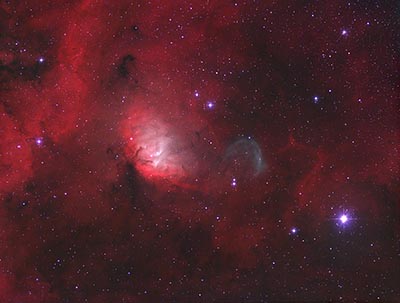
Cygnus - the Swan of a beautiful red nebla called the Tulip Nebula.
It looks like a side view of a tulip flower. Just to its right
is a jelly fish shaped greenish glow. This is the shock wave
from a nearby black hole as it strikes the surrounding gas. There
is nothing else like it in the entire galaxy.
This object is utterly
unique. This is the only target of this type that can be imaged
by amateur astroimagers in the entire galaxy. I spent months
aquiring data for this subject, most of it in OIII wavelengths.
Just left of center is the Tulip Nebula in Cygnus, also known
as Sharpless 2-101 and is a nicely detailed nebula shining in
reds and pinks from glowing hydrogen. Just to the right of center
we see a greenish "jelly fish" shaped object. This
is the bow shock from the Cygnus X-1 black holes northern jet
(visible only in radio wavelengths). It is ramming into the hydrogen
found here forming a parabolic shaped bow shock on its leading
edge. You can see it is filled in as well, highlighting the front
and back of the 3 dimensional shape of this object. Just below
it is a pair of stars, the lower one is HD226868 which the black
hole is orbiting. The southern jet does not produce a visible
trace as there is no nebulosity dense enough here to interact
with. This could possibly be the best color image of this black
holes bowshock ever taken.
Technical Data: 10"
f/3.9 Newtonian astrograph, Atik 16200 CCD, RGB HOORGB = 20.25
hours total, Payson, Az.
|  HOME GALAXIES EMISSION NEBS REFLECTION NEBS COMETS
GLOBULARS OPEN CLUST PLANETARIES LINKS