|
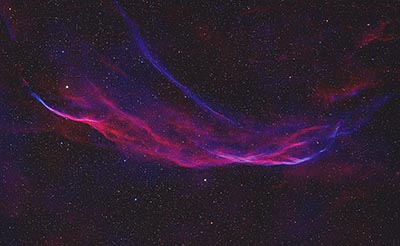
Twenty thousand years
ago, a star exploded in the constellation of Cygnus the Swan
lighting up the night sky with a beacon bright as the full moon
for months. Then it faded out. Today, we can see the expanding
wreckage from this burst as a series of shock waves expanding
outwards at high speed. Lighting up in shades of reds and blues,
this shock front is an beautiful series of arcs and filaments
for the camera and telescope. This is a 4 hour exposure from
Happy Jack with an 11 inch telescope.
This is the brightest
part of a large ring shaped SNR called G65.3+5.7 which spans
roughly 4 degrees in size near the star Alberio in Cygnus. This
bright section is Sharpless 2-91 and is a collection of super
nova shock fronts glowing with reds and blue/greens from the
collision with the interstellar medium. The rest of the ring
is much dimmer, and off the top of the frame here. The unofficial
name of this object is the "Little Veil Nebula".
Technical Data: 11"
f/2.2 RASA astrograph, ASI6200mm + Baader LRGB filters, Integration
time = 4h total, Happy Jack, Az.
|