|
Most of us are familiar
with the three belt stars of Orion in the winter sky, the three
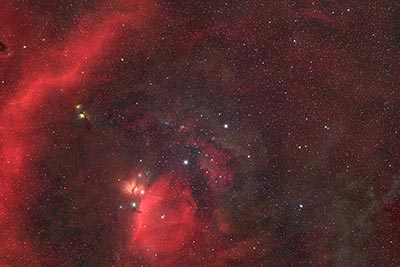
stars in a line are very obvious on a winters cold night. Hydrogen
is glowing everywhere in this telephoto shot. Just below center
is the Zeta Orionis complex, which is a collection of gas, dust,
and dark clouds. Look closely and you can just see the Horsehead
nebula. Upper left is a huge arc called Barnards Loop and is
a million year old super nova shock wave still lit by the three
belt stars. Yellow dust is seen here arcing just over the center.
This was taken in Payson with a 135mm f/2 Zeiss lens for nearly
6 hours of exposure time.
The neglected area just
north of the Orions three belt stars is a treasure trove of deep
sky targets. If you hold your hand over the Zeta Orionis complex,
you now can scrutinize the pink, blue and yellow clouds occupying
this offbeat area. Centered is IC426 and just above and to the
right is a seldom imaged arc of yellow dust which continues off
to the lower right. You can also see here that M78 is actually
contained in the periphery of Barnards Loop. Few yellow stars
occupy this image, most are blues and whites.
Technical Data: Zeiss
Milvus 135mm f/2, ASI2600mm + IDAS NBZ filter, RGB = 2 hours
total, Payson, Az.
|